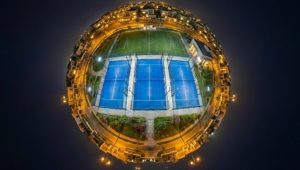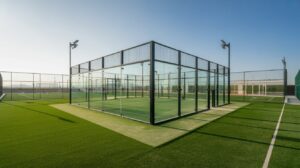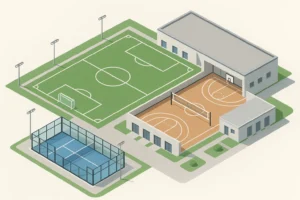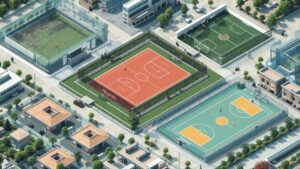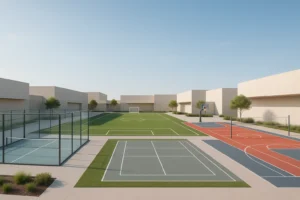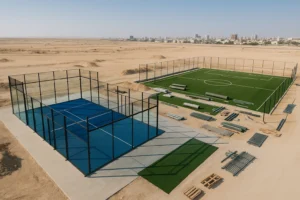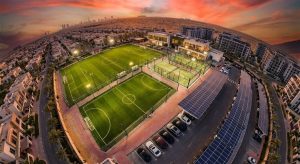
Searching for sports court construction UAE usually starts with one simple goal: build a facility that looks premium and performs correctly for years. In reality, the winning result depends on what happens under the surface—civil works accuracy, drainage behavior, structural stability, lighting comfort, and disciplined finishing. In the UAE, the climate adds another layer of pressure: heat cycles, humidity in coastal zones, dust exposure, frequent cleaning, and heavy booking schedules. That is why serious owners treat sports construction as an engineered system, not a quick installation. Almustaqbal Alsarea delivers turnkey delivery for clubs, schools, residential communities, hotels, and developers—covering planning, supply, execution, and after-sales support. This pillar guide is written for decision-makers who want clarity, not noise: how to plan a high-performance facility, how to compare contractors and suppliers, and how to build courts that stay safe, playable, and profitable in the UAE market. Ready to build? Start with a technical site visit and a scope that protects performance. Request a Quote & Site Visit | Explore Court Construction & Flooring Table of Contents What “Sports Court Construction UAE” Really Means A Practical Roadmap: From Site to Handover Approvals, Zoning, and Safety Responsibilities Civil Works, Base Accuracy, and Drainage Padel Court Construction: The UAE Standard Padel Court Construction Cost: How to Estimate Without Guessing Football Field Construction: Performance, Drainage, and Durability Indoor Courts: Vinyl Basketball Floor and Multi-Sport Halls Surface Systems: Turf, Rubber, EPDM & Acrylic Lighting, Accessories, and Player Comfort Maintenance That Protects ROI (and Reputation) How to Choose Sports Courts Suppliers in the UAE FAQ: UAE Court Construction Questions Conclusion: Build Once, Build Right 1) What “Sports Court Construction UAE” Really Means In many markets, sports construction is already demanding. In the UAE, it is more demanding because the environment accelerates weak decisions. A court may look perfect on day one and feel “cheap” after a few months if the base is not flat, drainage is ignored, joints are weak, or structural fixing methods are rushed. That is why sports court construction UAE should be approached as a long-term performance system. Owners typically judge a facility by results they can see and measure: consistent ball bounce, stable footing, safe rebounds, clean aesthetics, low downtime, and predictable maintenance costs. Those outcomes come from engineering discipline—not slogans. Whether the project is padel court construction, football field construction, or an indoor hall with a vinyl basketball floor, the winning formula is the same: accurate civil works, verified finishing, and maintenance-ready delivery. The UAE market also has a strong commercial reality: competition. New clubs open frequently, and users quickly compare playability, lighting comfort, surface quality, and overall experience. A facility that plays right earns repeat bookings, better reviews, and stronger membership retention. That is why smart investors treat construction decisions as brand decisions. Key takeaway: In the UAE, “premium” is not about expensive materials alone. It is about stability, accuracy, comfort, and predictable long-term performance. 2) A Practical Roadmap: From Site to Handover A professional build is not a single activity—it is a controlled sequence. When clients compare quotes, the smartest comparison is not “price vs price,” but “verification vs verification.” A proper scope makes each stage measurable, so quality is controlled before problems become visible. Phase A: Feasibility and Concept Planning The first phase decides whether the project will succeed commercially and technically. It includes sport mix selection (padel-only vs multi-sport), site constraints, access flow, parking logic, noise considerations, and the target user segment. A hotel court design differs from a high-usage club. A school court differs from a developer’s community court. The design must match the usage model from day one. Phase B: Engineering Scope and Specifications This phase defines the real build: civil works tolerances, drainage system design, structural frame specs, corrosion strategy, lighting targets (uniformity and glare control), surface system selection, and safety finishing details. If these items are not written clearly, the project becomes vulnerable to shortcuts. Phase C: Execution, QA, and Handover Execution is where credibility is built. Quality assurance should include base checks, alignment checks, fixing inspections, surface finishing review, line marking accuracy, and safe edge detailing. Handover should include a realistic maintenance plan and clear warranty boundaries that protect the owner. Stage What Happens What It Protects Feasibility Sport mix, site constraints, user model, access flow ROI, user experience, future expansion Specification Base tolerances, drainage, structure, lighting, surfaces Performance, durability, predictable quality Execution Civil works + installation + finishing + line marking Safety, playability, reduced downtime Handover QA checks, documentation, maintenance plan Long-term ROI, reputation, warranty clarity For turnkey delivery across key sports categories, explore: Padel Court Services, Football Fields Services, and Basketball Court Services. 3) Approvals, Zoning, and Safety Responsibilities Approvals and compliance should not be treated as a final step. They influence layout, drainage planning, lighting placement, and safety finishing. When approvals are considered early, the timeline becomes predictable. When approvals are ignored, projects face delays, redesigns, and avoidable cost increases. A turnkey contractor can reduce risk by coordinating documentation and engineering requirements from day one. What “Compliance” Means in Real Projects Compliance is not a single certificate. It is a behavior: correct dimensions for the sport, safe enclosures, stable structures, appropriate lighting, safe access, and responsible finishing. For sport references, many owners consult federation guidelines as a technical anchor— for example the International Padel Federation for padel, FIFA for football principles, and FIVB for volleyball. In practice, the build must also match the site and the UAE environment. Safety is a Business Asset Safety is not only a legal requirement—it is a commercial asset. Safe edges, controlled traction, and stable structures reduce injuries, complaints, and downtime. The facilities that maintain strong booking rates are usually the facilities that feel safe, clean, and consistent under real use. 4) Civil Works, Base Accuracy, and Drainage The base is where performance begins. Most long-term failures are not caused by surface materials; they are caused by weak base preparation. If the slab is not flat, you will see inconsistent bounce, accelerated seam stress, pooling