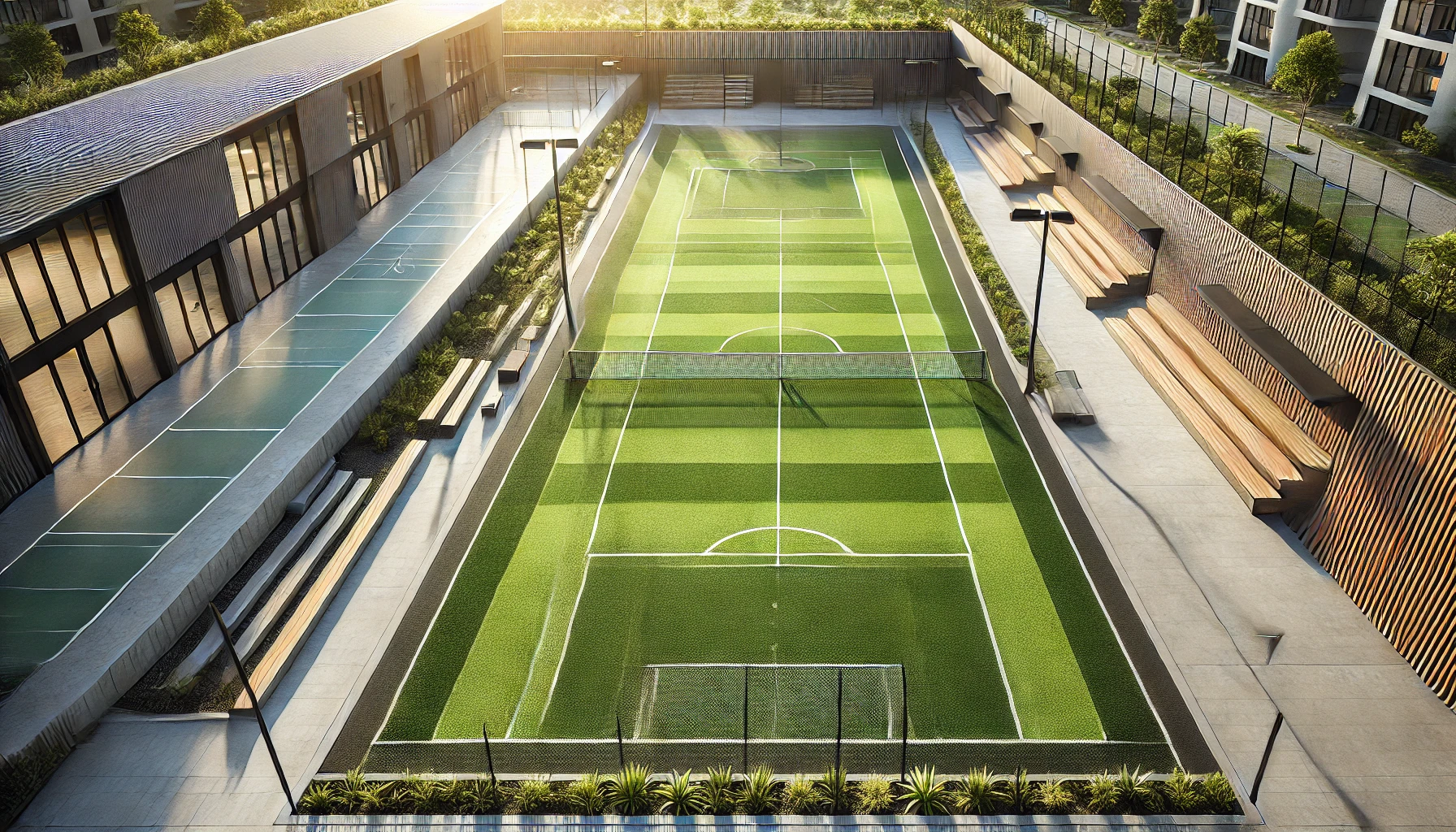
Perfect Sports Field Design is not a “nice-looking surface.” It is a complete performance system built for real usage: stable play, safe movement, predictable maintenance, and long-term durability. The right design turns a field into an asset that stays bookable, playable, and premium—especially under UAE heat, dust, frequent cleaning, and high booking schedules.
Request a Site Visit & Quote |
Explore Construction & Flooring Systems |
Visit Almustaqbal Alsarea
1) What “Perfect Sports Field Design” Really Means
People often judge a sports field by what they can see: the green color, the lines, the fencing, and the lights. But the performance you feel—ball roll, traction, shock response, and “premium stability”—comes from the system you don’t see: base engineering, drainage behavior, installation discipline, and finishing accuracy.
Whether you are designing a football training field, a community multi-sport court, or a padel and football combination facility, the same rule applies: the best projects are engineered to stay stable after handover.
For turnkey execution across popular categories in the UAE:
Football Fields,
Padel Courts,
Basketball Courts.
2) Sports Field Design Requirements: The Decisions That Control Everything
If you want a field that performs for years, start by writing your Sports Field Design Requirements. This single step prevents most “cheap-looking after 6 months” projects, because it turns vague wishes into measurable specifications.
A) Define Your Use Case (Not Just the Sport)
- Training vs competitions: Competition-style accuracy and lighting are different from daily training fields.
- Hours per day: High booking schedules demand a tougher system and a stricter maintenance plan.
- User profile: Kids, schools, academies, adults, and clubs each need different safety and durability priorities.
- Indoor vs outdoor: Outdoor needs UV stability, dust planning, and weather behavior management.
- Maintenance capacity: The best surface is the one your operation can keep “premium” every week.
B) Requirements Table: Match Design to Your Facility Type
| Facility Type | Primary Goal | Design Priority | Common Failure When Ignored |
|---|---|---|---|
| School | Safety + durability | Run-off safety zones, edge protection, easy cleaning | Slippery zones, damaged edges, high complaints |
| Community | Low downtime + stable look | Base accuracy, drainage behavior, durable surface | Pooling water, uneven play, early wear |
| Club / Academy | Performance + premium experience | Surface behavior + lighting comfort + finishing discipline | “Looks premium but feels wrong” |
| Hotel / Developer | Brand value + low-risk operation | Aesthetics + safety + maintenance-ready design | Rapid deterioration, reputational damage |
C) A Fast Requirements Checklist You Can Use Today
- Sport(s) and target dimensions (full-size, training, or community scale)
- Daily usage hours + peak hours
- Indoor/outdoor and expected cleaning frequency
- Surface system preference + acceptable alternatives
- Drainage expectations (water behavior after rain and cleaning)
- Lighting requirement (training vs competition comfort)
- Safety zones, fencing height, and access control
- Maintenance plan: who does it, how often, and with what tools
3) Professional Sports Field Planning: Site, Orientation, Utilities, and Risk
Professional Sports Field Planning is where high-performing projects separate from “quick installs.” A good plan reduces timeline risk, protects budget, and prevents redesigns after construction starts.
A) Site Assessment That Actually Matters
- Soil behavior: soft zones and inconsistent compaction create future settlement.
- Water behavior: where does water go after rain or wash-down?
- Level differences: transitions around the field often cause weak edges and trip points.
- Utilities: power for lighting, water lines (if needed), and safe routing.
- Access: delivery access, emergency access, and service access for maintenance.
B) Orientation and Player Comfort
Sun direction affects comfort and visibility. In outdoor UAE projects, glare during late afternoon can affect training quality. Planning orientation and lighting together avoids expensive “fixes” later.
C) Planning Output: What You Should Receive Before Build Starts
| Deliverable | What It Includes | What It Protects |
|---|---|---|
| Site concept layout | Orientation, access, safety perimeter, zones | User flow, safety, future expansion |
| Specification scope | Surface system, base layers, drainage, lighting | Quality control and quote comparability |
| Execution roadmap | Stages, inspections, handover checklist | Reduced rework and predictable delivery |
4) Choosing the Right Surface System for Your Sport and Usage
Surface selection should match your goals, not trends. A surface that is “great on paper” becomes a problem if it does not match your cleaning frequency, booking intensity, and climate exposure.
Surface Systems Comparison (Operator View)
| Surface System | Best For | Key Strength | What Must Be Done Right |
|---|---|---|---|
| Football Artificial Turf | Training fields, academies, commercial fields | High uptime + durable playability | Base accuracy, seams, infill distribution, drainage behavior |
| Natural Grass | Premium competition fields with strong maintenance team | Natural feel | Irrigation, drainage, daily care and recovery planning |
| Acrylic Court System | Outdoor basketball/multi-sport courts | UV-ready finish + good traction | Crack control, base preparation, finishing layers |
| Padel Turf System | Padel courts (indoor/outdoor) | Controlled grip + premium play feel | Seam discipline, clean edges, infill control, enclosure stability |
For padel and court surface systems:
Padel Court Construction |
Padel Court Services
For multi-sport flooring context and system selection:
From Padel Courts to Vinyl Basketball Floors
5) Civil Works, Base Accuracy, and Drainage: Where Most Fields Win or Fail
The #1 reason fields feel “cheap” after handover is not the surface brand—it is the base. If the base is uneven or unstable, you will get inconsistent play, pooling water, accelerated wear, and constant patch repairs.
A) Base Accuracy: “Looks Level” Is Not a Standard
Professional delivery is based on measurable tolerances. Flatness, compaction, and transitions must be controlled before any surface is installed. Once the surface is installed, mistakes become expensive and disruptive.
B) Drainage: Protecting Uptime
Drainage planning protects your operating hours. In the UAE, even if rainfall is limited, frequent wash-down cycles and water runoff still create downtime if water behavior is not managed correctly.
Errors vs Correct Method (Field Reality)
| Common Shortcut | What Happens After Use | Correct Practice |
|---|---|---|
| Weak compaction control | Soft zones, settlement, uneven play | Layer-by-layer compaction with verification |
| Ignoring runoff paths | Pooling water, stains, downtime | Drainage logic designed, executed, and tested |
| Surface installed over weak transitions | Edge lifting, cracks, trip points | Clean perimeter detailing and stable edge build-up |
For full-system delivery and verified execution stages:
Court Construction & Flooring
6) Safety, Run-Off Areas, Fencing, and Player Protection
Safety is not an optional feature—it is part of performance and reputation. The safest fields are the fields that keep operating without incidents, complaints, or forced downtime.
A) Run-Off Safety Zones
Run-off areas give players space to decelerate safely. They also protect the playing surface edges from constant damage. If you reduce run-off zones to “save area,” you often create recurring injury and maintenance issues.
B) Fencing and Access Control
Fencing isn’t only to stop the ball; it protects operations. Proper gates, entry flow, and protected service access keep maintenance easy and reduce misuse.
C) References for Rules and Pitch Concepts
For official field-of-play definitions and dimensions references:
7) Lighting Comfort: Visibility Without Glare
Lighting is one of the fastest ways a field can feel premium—or uncomfortable. Operators often focus on brightness, but users remember comfort: even coverage, low glare, and clear visibility of the ball.
What Good Lighting Achieves
- Consistent visibility across the entire field (no “dark corners”).
- Reduced glare and eye fatigue during night play.
- Long-term reliability under heat cycles and outdoor exposure.
8) Operational Details: Benches, Access, Storage, and Finishing
Small details decide whether a facility feels “organized and professional” or “unfinished.” Finishing quality is where visitors form their first impression, and where operators feel the difference every day.
A) Essentials That Improve Daily Operation
- Team bench zones and technical area layouts (simple, clean, functional).
- Safe gate placement and durable locks.
- Storage zone planning (balls, cones, nets, cleaning tools).
- Clear signage and controlled entry flow for busy facilities.
B) Finish Discipline: The Premium Look That Lasts
Clean edges, stable corners, and consistent line marking protect both appearance and safety. This is where quick projects show weakness under dust, cleaning, and heavy use.
9) Maintenance That Protects ROI (and Reputation)
Every field has maintenance—what changes is whether maintenance is predictable and easy, or constant and expensive. Maintenance should be planned during design, not after handover.
Practical Maintenance Schedule (Simple and Effective)
| Frequency | What to Do | Why It Matters |
|---|---|---|
| Daily / After peak | Remove debris, quick inspection of gates and edges | Prevents small issues becoming downtime |
| Weekly | Inspect seams, corners, high-traffic zones | Extends surface life and keeps play consistent |
| Monthly | Deep cleaning, check lighting, review infill behavior | Protects comfort and premium perception |
| Quarterly | Detailed condition review + minor repairs | Prevents expensive rework later |
For business-oriented planning of sports facilities:
How to Build a Profitable Sports Facility
10) Budgeting Without Guessing: Cost Drivers That Matter
Budget becomes easy when scope is clear. Budget becomes risky when scope is vague. The biggest trap is comparing “price vs price” instead of comparing “verification vs verification.”
Cost Drivers Table (CAPEX vs Value)
| Cost Driver | What It Changes | Why It Matters |
|---|---|---|
| Base and civil works | Flatness, stability, lifespan | Protects everything above it |
| Drainage behavior | Uptime and safety | Less downtime = more revenue |
| Surface system quality | Play feel and wear rate | Users feel the difference immediately |
| Lighting engineering | Comfort and operating hours | Night play is a core driver in the UAE |
11) How to Compare Contractors and Suppliers Like an Operator
This is where many projects make expensive mistakes. A great product can fail under weak execution, and a “good enough” product can perform better with disciplined installation. Compare providers as performance partners—not as sellers.
Bid Comparison Table (Ask for Proof, Not Promises)
| What to Compare | Strong Answer Looks Like | Weak Answer Looks Like |
|---|---|---|
| Scope clarity | Inclusions/exclusions and measurable specs | Vague “turnkey” without details |
| Verification | Checks before surface installation and at handover | “We always do it right” |
| Maintenance plan | Real schedule matched to usage | No plan until after problems start |
| After-sales support | Clear response process and boundaries | Unclear responsibilities after handover |
If you want a single accountable partner for planning, execution, and handover:
Contact Almustaqbal Alsarea
12) UAE Reality Check: Climate, Dust, Humidity, and Heavy Usage
Design choices that survive in mild climates can fail quickly in the UAE. Heat cycles, coastal humidity, dust exposure, frequent wash-down, and heavy bookings accelerate weak decisions. A system designed for UAE conditions focuses on:
- Stable base and edges: to resist movement under heat and intense usage.
- Water behavior control: runoff and drainage that keeps the field open.
- Comfort planning: lighting comfort, safe traction, and stable play feel.
- Maintenance realism: the “best design” is the one your team can keep premium.
13) Why Custom Sports Field Construction Works Best as One Accountable System
Custom Sports Field Construction becomes risky when responsibilities are fragmented—one party for civil works, another for surface, another for lighting. When something fails, each party points to the other. The strongest projects are delivered as one system, with one accountable scope and one measurable quality method.
What “Turnkey” Should Mean in Real Life
- Planning + site constraints captured early
- Written specifications that match the use case
- Execution stages with verification
- Handover with maintenance-ready documentation
- After-sales support process that protects uptime
Almustaqbal Alsarea delivers fields and courts as performance assets—planning, supply, execution, finishing, and handover with clarity that protects long-term operation.
Request a Site Visit & Quote |
Football Field Solutions |
Court Solutions
14) FAQ: Quick Answers Decision-Makers Actually Need
Q1) What is the fastest way to choose the right field design?
Write your Sports Field Design Requirements first: usage hours, user profile, maintenance capacity, indoor/outdoor exposure, and performance priorities. Then select the surface system and base method that match those requirements.
Q2) What makes a field feel “premium” to users?
Consistency and comfort: stable footing, predictable ball behavior, safe run-off zones, and lighting that feels bright without glare.
Q3) What is the biggest mistake in sports field projects?
Treating the surface as the main decision while ignoring base accuracy and drainage behavior. Most long-term failures start under the surface.
Q4) How do I compare contractors beyond price?
Compare verification methods: base checks, drainage testing, finishing control, and a realistic maintenance plan. Vague answers usually become expensive later.
Q5) Why does one accountable partner matter?
Because Custom Sports Field Construction is an integrated system. When responsibility is fragmented, quality gaps appear at interfaces (base-to-surface, surface-to-edges, lighting-to-comfort). One accountable scope reduces risk.
15) Conclusion: Build Once, Build Right
The best Perfect Sports Field Design is the design that stays stable and profitable after handover. When Professional Sports Field Planning is done correctly, your project becomes predictable: fewer repairs, higher player satisfaction, and stronger long-term value. Start with Sports Field Design Requirements, choose the right surface system, protect the base and drainage, then deliver as one measured system through Custom Sports Field Construction.